
Final Stakeholder Meeting on Revised Lao PDR Nationally Determined Contribution (NDC 3.0), From Commitment to Action
Remarks by the Resident Coordinator a.i.
Your Excellency Madam Chanthakhone Boualaphan, Vice Minister of Agriculture and Environment,
Ms. Ayshanie Medagangoda-Labé, Resident Representative of UNDP,
Distinguished representatives of ministries and government agencies,
Representatives of development partners, civil society, the private sector, and academia,
Colleagues from the United Nations,
Ladies and gentlemen,
Sabaidee and good morning.
As the Resident Coordinator a.i., it is my great pleasure to join you today for this final stakeholder meeting on the revised Nationally Determined Contribution, or NDC 3.0 of Lao PDR. At the outset, I would like to commend the Government of Lao PDR, particularly the Ministry of Agriculture and Environment and its Department of Environment, for its leadership in guiding this important national process. I also wish to acknowledge the valuable contributions of line ministries, technical institutions, development partners, civil society organizations, private sector representatives, academic institutions, and community stakeholders whose insights and expertise have helped shape the revised NDC.
Climate change is no longer a distant challenge. Its impacts are already being felt across Lao PDR through increasingly frequent floods, droughts, storms, rising temperatures, and changing rainfall patterns. These impacts affect agriculture, water resources, infrastructure, health, education, livelihoods, and ultimately the country's economic resilience and development prospects.
For this reason, NDC 3.0 must be more than an international commitment. It must serve as a practical national roadmap for safeguarding communities, strengthening resilience, and advancing a low-emission and climate-resilient development pathway. Today marks an important milestone in a sustained and highly collaborative process.
At the request of the Government, the United Nations Country Team came together to identify and mobilize the expertise, programmes, and resources that different UN entities could contribute to the NDC revision. This collective offer of support was aligned with national priorities and translated into a coordinated approach led by the Government.
Government institutions provided leadership across priority sectors, while UN entities and development partners contributed technical expertise within their respective mandates. Sector focal points worked closely together on assessments, data collection, modelling, target setting, consultations, financing requirements, and institutional arrangements.
The Resident Coordinator's Office facilitated the overall coordination of this effort, while UNDP served as the technical lead. I would like to recognize the important contributions of FAO, UNOPS, UN-Habitat, UNICEF, WHO, WFP, UNDRR, ILO, UNIDO, UNEP, GGGI, WWF, and many other partners who supported this process.
This collaborative model has helped ensure that mitigation, adaptation, and broader development priorities are addressed in an integrated manner across agriculture, forestry and land use, energy, transport, industry, waste management, water resources, health, urban development, and education. It has also strengthened attention to gender equality, children and youth, decent work, the private sector, a just transition, and addressing loss and damage.
The revised NDC also presents an important opportunity to align near-term climate action with Lao PDR's long-term development aspirations. Its targets and measures can reinforce the 10th National Socio-Economic Development Plan, the National Green Growth Strategy, the National Adaptation Plan, the National Disaster Risk Reduction Strategy, and the country's Long-Term Low-Emission Development Strategy and 2050 net-zero vision.
As we move toward finalization and submission ahead of COP31, allow me to highlight three priorities.
First, national ownership and inclusiveness must remain at the heart of implementation. Climate action cannot be the responsibility of a single ministry or institution. It requires a whole-of-government approach across national and subnational levels, as well as a whole-of-society approach that engages communities, local authorities, academia, civil society, women, young people, persons with disabilities, farmers, workers, and the private sector.
Second, the NDC must serve as a bridge from ambition to implementation. The revised NDC provides stronger sectoral pathways and greater attention to costing, implementation arrangements, technology requirements, and capacity needs. The next step is to translate this foundation into actionable implementation and investment plans that can deliver tangible results.
Third, ambition must be matched by adequate and accessible financing. Public resources will remain critical, but they will not be sufficient on their own. Lao PDR will need to mobilize domestic resources while expanding access to international climate finance, development cooperation, responsible private-sector investment, results-based financing mechanisms, and, where appropriate, high-integrity carbon market opportunities.
Ladies and gentlemen,
Today's meeting is therefore not simply the final step in preparing a document. Rather, it marks the beginning of a new phase focused on implementation, delivery, and results.
The United Nations remains fully committed to supporting Lao PDR in implementing NDC 3.0. Working as One UN, and under the leadership of the Government, we will continue to support policy integration, institutional capacity development, climate finance mobilization, data and transparency systems, inclusive participation, and the development of programmes that deliver measurable benefits for people and communities across the country.
By moving together from commitment to action, Lao PDR can build a more resilient, prosperous, and sustainable future for current and future generations.
I wish you a productive and successful meeting.
Khop chai lai lai.



ຄຳປາໄສໂດຍ
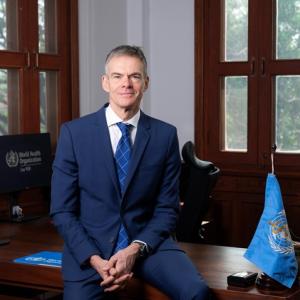
ດຣ ທິມໂມຕີ ອາມສະຕຣອງ
ບັນດາເປົ້າໝາຍທີ່ພວກເຮົາສະໜັບສະໜູນຜ່ານຂໍ້ລິເລີ່ມນີ້


