
Second biannual UNCT–INGO Meeting 2026
Remarks by the Resident Coordinator
Good afternoon, and welcome to UN House. I am pleased to co-chair today’s dialogue with Jesper Lauridsen, Chair of the INGO Network, and to see colleagues from the INGO Network and the UN Country Team at this second INGO-UNCT meeting of 2026.
There is clearly growing interest in using this forum for collaboration at the policy and operational, system-to-system levels. Building on a good exchange in our last meeting in June, today we will touch on several concrete actions that have followed from it. I would particularly like to thank Pathana, INGO Network Coordinator, and Vankham, RCO Partnerships Officer, for working behind the scenes to ensure that today’s agenda reflects the priorities and interests of this group.
Let me begin with the broader context and then turn to what it means for our partnership here in Lao PDR.
As you will be aware, the 81st UN General Assembly is well underway. This is the final UNGA under the current Secretary-General, and the UN80 reform discussions are moving from proposals towards what the Secretary-General has described as a third phase – that of decisions and implementation. Member States have broadly supported the objectives of greater coherence, less fragmentation and stronger UN coordination, while emphasizing that reform must remain firmly country-focused and responsive to national priorities. The Lao delegation, led by the Deputy Prime Minister and Minister of Foreign Affairs, has attended the high-level segment of the UNGA last week. The DPM’s meeting with the Deputy Secretary-General provided an opportunity to express the Government’s broad support for the UN80 initiatives.
That global emphasis on coherence and country-level impact connects directly to the next phase of our work in Lao PDR. We have now a signed 2027-2031 Lao PDR – UN Sustainable Development Cooperation Framework, which will set the strategic direction for UN support over the next five years. We have had several stakeholder consultations on developing the new Cooperation Framework, including with the INGO network. The Country Programme Documents of UNDP, UNFPA and UNICEF for the same period have been approved too. Together, the Cooperation Framework and the corresponding agency Country Programmes align with the 10th National Socio-Economic Development Plan and support the thrust of the LDC Smooth Transition Strategy.
The 2027-2031 Cooperation Framework will be launched with the Government on 21 October, and we will be inviting development partners including INGOs to this event. The short ceremony will be co-hosted by the Deputy Prime Minister and Minister of Foreign Affairs. We will share the invitation with the INGO Network shortly.
The new Cooperation Framework gives us a timely opportunity to make the UN-INGO partnership more systematic and more results-oriented. Our engagement to-date was part of our commitment made in our Partnership Strategy. Looking ahead, we are keen to retain this dialogue as part of our partnership approaches for the next Cooperation Framework cycle, with a stronger focus on practical outcomes. Our biannual dialogue could be organized around issues of common interest, combining focused discussion on shared thematic priorities with updates on key national processes, including the NSEDP, the Round Table Meeting, LDC graduation, and SDG implementation, more broadly.
We can complement our dialogue with more deliberate joint advocacy. Marking 70 years of Lao PDR’s membership to the UN, we have been advocating for more youth engagement under our LaoUN70 campaign. I’m pleased to share that last month we launched the Youth Advisory Board, comprised of 10 young people from different walks of life and different parts of the country. The UN’s work on PSEA will also continue and deepen under the new Cooperation Framework that includes a dedicated PSEA clause.
In preparation for the 2027 High-Level Political Forum in New York, the Government will undertake its fourth Voluntary National Review of progress towards the Sustainable Development Goals. This VNR will also mark an important milestone: for the first time, a Voluntary Local Review will be undertaken in Savannakhet, with its findings incorporated into the national VNR. The UN Country Team is supporting this Government-led process and is committed to facilitating broad and meaningful participation. Stakeholder engagement will begin soon for both the VNR and VLR processes, and I hope that the Network’s experiences and perspectives contribute to the analysis and recommendations.
Looking at all of these collaboration ideas, I propose that the INGO Network Coordinator and my Office map our respective activities and areas of interest, identify where joint action can add value, and use that work to help shape a partnership framework, which – at this end – will feed into UN’s new Partnership Strategy.
This brings us directly to today’s agenda, which gives us an opportunity to move from strategic intent to practical collaboration. We will discuss the INGO Network’s five-year strategy; preparations for the Round Table Implementation Meeting; findings from the joint flood assessment and our collective work on disaster resilience; and opportunities for joint advocacy, including the 16 Days of Activism and the 20th anniversary of the Convention on the Rights of Persons with Disabilities (International Day of Persons with Disability).
I look forward to hearing the perspectives of the INGO Network and to a constructive discussion on the concrete steps we can take together, next.
Thank you.


Speech by
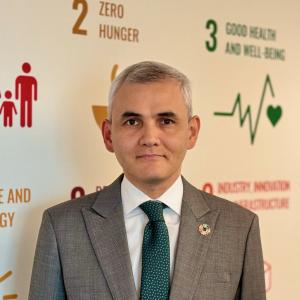
Mr. Bakhodir Burkhanov
Goals we are supporting through this initiative


