
ESCAP Workshop on Strengthening the Capacity to Formulate Trade Policy and Strategy for a Post-Graduation Landscape
Opening Remarks by UN Resident Coordinator
Excellency Dr. Manothong Vongsay, Deputy Minister of Industry and Commerce
Mr. Oliver Paddison, Chief of Section on Sustainable Development and Countries in Special Situations
Invited international guests and participants
Directors-General and DDGs of the Lao PDR Government, UN agency and Development Partner colleagues, subject matter experts joining online
Ladies and gentleman:
A warm welcome to you all. Thank you for joining us today.
Our workshop today is of significance in several ways. It is the first engagement on LDC graduation and trade policy jointly developed with contributions from the Ministry of Industry and Commerce, the Ministry of Foreign Affairs, and the UN System. I appreciate the spirit of collaboration that has made today’s event possible.
The workshop also carries importance in that it comes at a critical time in Lao PDR’s pathway to LDC graduation. For Laos, graduation from LDC status is an important marker of sustained economic and social progress, and a transition which will elicit changes in the areas of trade, investment and multilateral support. Few of those changes would happen overnight, and most will be phased in gradually over transitional periods of three to four years.
At the 81st UN General Assembly last week, Deputy Prime Minister and Minister of Foreign Affairs H.E. Thongsavan Phomvihane reaffirmed Lao PDR’s commitment to a quality, smooth and sustainable LDC graduation. But in some ways, the transition ahead for Lao PDR is a passage into less-familiar territory. It requires careful navigation, know-how and continued support from international community. It is in that vein that the Foreign Minister has aptly called for predictable transition arrangements, continued international support measures, and concessional financing to safeguard hard-won gains.
And this offers a perfect framing for today’s discussion. We are greatly appreciative of Dr. Mohammad Abdur Razzaque, the ESCAP team, and the representatives of recently graduated LDCs that join us today to reflect on the real and lived experiences of such transitions. Your reflections come at a most opportune time.
Let me share some words on our context for the benefit of those new to Lao PDR. Published in December 2023, the Smooth Transition Strategy for LDC Graduation is the main policy framework for Lao PDR to prepare for LDC graduation in a changing international context. It contains 22 action areas under four pillars, with the goal of securing a smooth, high-quality and sustainable graduation. ‘Sustainable’ in this context also carries an important connotation of irreversibility.
Building on the Smooth Transition Strategy, the UN System has supported the Ministry of Foreign Affairs in the development of the LDC Graduation Readiness Assessment, finalized in mid-2025. The Assessment elaborates on part 2 of Smooth Transition Strategy to provide more detail on the specific transitions in trade, development finance and technical support arrangements that Lao PDR is set to experience. These transitions will occur – or begin to occur – when Lao PDR graduates from LDC status in November 2026.
Recommendations of the Graduation Readiness Assessment are of direct relevance to our discussions over the course of this workshop. These include efforts to remove or minimise non-tariff barriers to trade for Lao PDR, to build capacity in modelling the benefits of trade and capacities to pursue preferential trade agreements, and intensifying efforts in trade facilitation such as promoting paperless and digital trade. As the UN System, we stand ready to support further implementation of reforms in these areas, and across other recommendations of the Graduation Readiness Assessment.
Indeed, post-graduation development pathways is a key thrust of the new five-year Lao PDR—UN Sustainable Development Cooperation Framework that will commence in 2027. United behind supporting this national effort are 24 UN entities, agencies, funds and programmes, including the ESCAP.
Importantly, just as graduation from LDC status is a shared achievement by the Government and people of Lao PDR and its thriving private sector, the transitions ahead require the same shared commitment and a whole-of-society engagement. It is in this spirit that this week’s workshop concludes with a briefing to private sector and development partners at this very venue on Friday. It will tackle important subjects such as how government institutions, firms and workers adjust effectively to the post-LDC operating environment. Let me warmly encourage you to join and contribute to that discussion, just as many presenters of our workshop in the coming days have committed to do so.
Lastly, this week’s workshop is a tremendous achievement for our colleagues at ESCAP. The Regional Economic Commission’s extensive technical expertise and programme of work with Lao PDR is highly valued by the UN Country Team. As Resident Coordinator, I am thrilled to count on ESCAP as the newest member of the UN Country Team in our next five-year UN programme cycle for Lao PDR beginning next year. Engagements such as our workshop today bode well for our shared goal of delivering UN’s expert support, policy advice and development finance as the country moves past its LDC graduation milestone.
Let me thank you once again for your participation and prospective contributions over the course of this workshop, with our special thanks to Dr. Manothong Vongsay, Deputy Minister of Industry and Commerce, colleagues at the MOIC and MOFA, and to Oliver and the ESCAP team for preparing such a critical learning opportunity for Lao PDR, despite the challenging circumstances of travel from Bangkok.
I wish you all the very best for the discussions over the next days.


Speech by
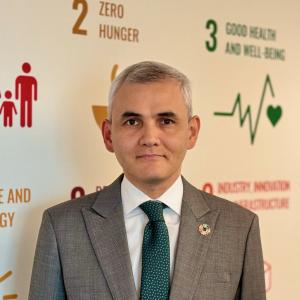
Mr. Bakhodir Burkhanov
Goals we are supporting through this initiative


